Portuguese Translation Services in India: Meeting the Language Needs of Global Business
New opportunities in India’s commercial relationship with Portuguese-speaking markets are bringing greater attention to the role of multilingual communication in international business. From trade documentation and industrial projects to digital services and pharmaceutical exports, Portuguese Translation Services in India can help companies communicate with overseas partners and prepare business information for different markets.
In May 2026, Portugal’s Secretary of State for the Economy led a business delegation to India to explore opportunities in sectors including renewable energy, infrastructure, technology, healthcare, pharmaceuticals and industrial development. The visit reflected continued efforts to strengthen commercial cooperation and identify opportunities for Portuguese businesses in the Indian market.
One Language, Multiple Business Markets
Portuguese is used across several countries and regions, including Portugal, Brazil, Angola and Mozambique. For Indian companies expanding internationally, this creates translation requirements that extend beyond a single destination.
However, Portuguese content is not always interchangeable across markets. European Portuguese and Brazilian Portuguese differ in vocabulary, usage and certain language conventions. Business documents, product information and customer-facing content must therefore be prepared with the intended country and audience in mind.
For exporters, selecting the appropriate language variant can be particularly important when preparing commercial proposals, product catalogues, websites and communication for local distributors.
Where Businesses Need Portuguese Translation
Translation requirements often emerge at different stages of an international project. Before entering a new market, a company may need to translate its corporate profile, business presentation and product information. During procurement and project execution, requirements may include contracts, technical specifications, supplier correspondence and operational manuals.
Industrial businesses may need Portuguese translations of equipment documentation, installation instructions, maintenance procedures and workplace safety materials. Pharmaceutical and healthcare organisations may require specialised translation of product information, technical records and related documentation, subject to the relevant market requirements.
For technology companies, website localisation, software interfaces, user instructions and digital content can help make products accessible to Portuguese-speaking customers. Each assignment requires an approach suited to its subject matter, audience and intended use.
Accuracy Has Direct Business Value
Translation quality can influence how commercial and technical information is understood by customers, suppliers and project teams. An unclear contractual clause, inconsistent product specification or incorrectly translated instruction can create unnecessary questions and delays.
A structured translation process may include terminology research, proofreading, numerical checks and consistency reviews. Technical assignments may benefit from reference glossaries, while marketing content requires attention to tone and cultural context.
Confidentiality also matters when companies share pricing information, financial records, intellectual property or commercial agreements. Businesses should establish suitable document-handling arrangements and confirm project requirements before transferring sensitive materials.
Documentation for Official and Personal Requirements
Portuguese translation is also relevant to individuals dealing with education, employment, immigration and administrative procedures involving Portuguese-speaking countries. Documents may include academic certificates, birth and marriage records, employment letters and other official paperwork.
The receiving authority determines whether a certified or sworn translation, a specific format or additional authentication is required. Requirements can differ between countries and institutions, so applicants should verify the applicable process before commissioning their translations.
Supporting Communication Beyond Written Documents
International projects frequently involve meetings, supplier discussions, training sessions and business negotiations. Portuguese interpretation can help participants communicate when they do not share a common language.
Companies may also require transcription, subtitling and voice-over for recorded meetings, corporate training videos, product demonstrations and presentations. Coordinating these services can help maintain consistent terminology across documents and multimedia materials.
Preparing for International Opportunities
As businesses explore opportunities across Portuguese-speaking markets, language planning can support more effective commercial communication. Identifying the target country, document purpose, language direction and quality requirements at the beginning of a project helps establish an appropriate workflow.
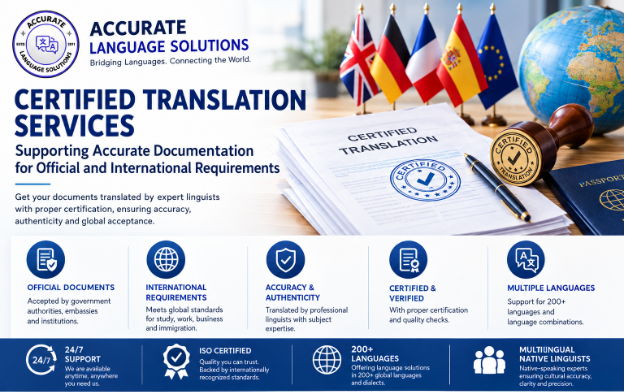
Accurate Language Solutions provides multilingual communication services, including translation, interpretation, transcription and voice-over. Businesses and individuals can learn more at https://accuratelangsols.com/.
Portuguese translation is more than a document-conversion requirement. When handled with appropriate linguistic and subject expertise, it can help Indian organisations communicate their offerings, exchange information accurately and manage professional relationships across international markets.

